Third-party depot repair in Canada, for programs leaving a US depot.
For service and after-sales leaders at US and global OEMs, distributors, and warranty programs whose Canadian units still cross the border twice to get fixed.
REPAIRING ELECTRONICS IN CANADA SINCE 1994 MARKHAM, ONTARIO BOARD & BGA LEVEL
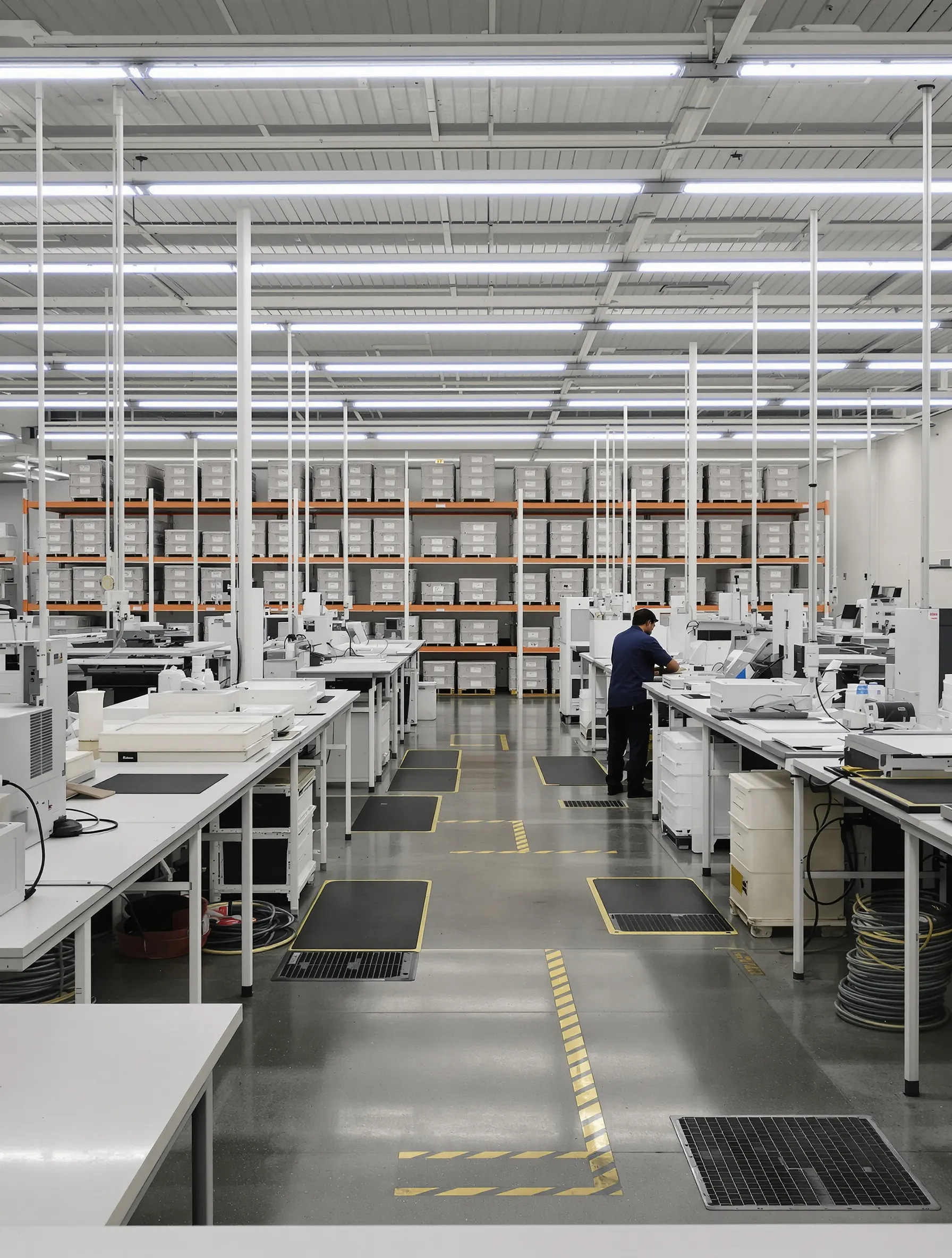
What outsourced depot repair services in Canada are, and who buys them
Outsourced depot repair is the arrangement where a third-party facility repairs your product under your program rules instead of you running a depot yourself: units ship to one building, get checked in by serial number, diagnosed, repaired, tested, and returned. Outsourced depot repair services in Canada exist because Canadian volume is rarely large enough to justify a facility of your own, and always large enough to hurt when it is serviced from another country.
The buyer is usually a director of service or after-sales at a US or global manufacturer, a distributor running a warranty or extended-warranty program, or anyone who needs contract repair services in Canada without a lease. What you are buying is a repair and warranty program in someone else’s building.
The depot behind the program
Microland has repaired electronics in Canada since 1994, from one facility in Markham, Ontario. The shortest answer to the trust question is that manufacturers already put their own warranty work through these benches.
- Sony
- Yamaha
- QSC and Q-SYS
- Onkyo and Pioneer
- Rotel and Monitor Audio
- Cambridge Audio
In-warranty and out-of-warranty repair for each of these brands is handled in Markham, with genuine parts, under the manufacturer’s terms. Across every category we serve, Microland is an authorized service centre for more than 100 brands.
What cross-border warranty repair in Canada actually costs
Every Canadian unit repaired in a US depot crosses the border twice, and each crossing adds freight, brokerage, paperwork, and time inside your turnaround clock. None of it is repair. It is the cost of the address.
Border days inside your turnaround clock
Two crossings per repair, each one unpredictable. Customs time is not repair time, but the SLA miss still lands on you.
Brokerage and paperwork on every RMA
Proof of export, repair-value declarations, and per-shipment filings, both directions. One error surfaces months later as a duty bill.
Tariff exposure on repaired goods
The 2025 rounds put 25% on Canadian imports into the US, no exclusions. Our own analysis put a $1,000 unit sent south at $200 per repair.
Two-way freight before any bench time
Freight south, freight north, brokerage on both legs, all before a minute of bench time.
A Canadian customer base served from abroad
Channel partners inherit the invoices and battery-shipping rules, and end users watch tracking go quiet at the border, which is when they call you.
Data leaving Canadian jurisdiction twice per repair
Every data-bearing device crosses out and back. Canadian enterprises increasingly require that data, and the hardware holding it, stay in country.
Goods returned to the US after repair abroad are assessed on the value of the repair, and the 2025 duties were not excluded for those provisions, so even Canadian repair labour can attract them. A loop that never touches the border is exposed to none of it. The math is in our tariff analysis.
How third-party depot repair works when we run it
As your third-party depot we take the whole loop: intake and triage, in-warranty and out-of-warranty repair, advance exchange, parts, screening and refurbishment, and the reporting your systems read. You keep the program; we keep the building and the bench.
- STEP 01
Intake and triage
Units check in against an RMA or manifest, serial by serial, and technicians verify the reported fault before any bench time. No-fault-found units get caught here, not after a repair cycle.
- STEP 02
In-warranty repair under your terms
Your coverage rules, test criteria, and procedures govern the work, on genuine OEM parts, documented per unit, so entitlement decisions stay auditable.
- STEP 03
Out-of-warranty repair, approval first
As your out-of-warranty repair partner we diagnose, quote, and wait: estimates are approved in the portal before work starts, and paid repairs carry our own service warranty.
- STEP 04
Advance exchange from stock we hold
A working unit ships from buffer stock the moment a claim is approved, and the failed unit follows and is repaired back into the pool. Downtime becomes courier transit.
- STEP 05
Parts, harvesting, and test fixtures
We source and hold your parts pool, harvest where your program allows it, and build fixtures to your procedures. Board and BGA-level rework recovers what part-swappers scrap.
- STEP 06
Screening, refurbishment, and disposition
Returns that are not warranty repairs still need a destination: screened, graded, refurbished, resold, or retired, on benches in the same building. No second vendor for the tail.
- STEP 07
Portal, REST API, and reporting
Every unit is visible in real time in a portal your team can act in, and the full REST API puts the same data into your own systems. Built in house, so it gets tailored per program.
Bench detail: depot repair, advance exchange, board-level repair.
The transition plan: moving a program out of a US depot
Moving a repair program is a sequenced project, not a switch flip: audit what the incumbent holds, stand the program up here, move buffer stock and parts north, cut over new RMA intake on a fixed date while in-flight units finish at the old depot, then wind down and repatriate. In that order, your end users experience nothing.
| Step | What happens | Who does it | Planning envelope |
|---|---|---|---|
| 01 Audit and scoping | Serialized census of every unit at the incumbent depot, pool and parts ownership, entitlement export, contract review. | Joint, with the incumbent on the export. We run the census. | 2 to 4 weeks |
| 02 Program stand-up in Markham | SKUs loaded, test criteria documented, parts sourced, portal and API live in a test environment. | Microland, from your program documentation. | 3 to 6 weeks, overlapping the audit |
| 03 Buffer stock and parts pool move | Exchange and parts pools ship north under the returned-goods provisions, clear customs, and are counted here. | Microland, with your customs broker. | 2 to 4 weeks |
| 04 First articles and parallel run | Real failed units run the full loop here and are signed off against your test criteria, then intake ramps. | Joint. You sign off the first articles. | 2 to 4 weeks |
| 05 Cutover | Every new RMA routes here from the date, and every routing surface changes at once: portal, warranty system, labels, inserts, scripts. | You own the routing surfaces. We own the dock. | One fixed date |
| 06 Wind-down and repatriation | In-flight units drain within a turnaround cycle, the old depot reconciles against the audit baseline, remaining stock comes home. | Microland, including the repatriation paperwork. | 4 to 8 week tail |
Envelopes are planning figures for a mid-sized program, not promises: program size, SKU count, and contract terms move every number. The step by step version is in the transition playbook.
Want this mapped against your program? We will do the audit.
The six things procurement asks first
These are the objections that decide whether warranty repair outsourcing happens. None of them has a clever answer, only an operational one.
“Our Canadian volume is too small to justify a separate depot”
Correct, and that is the argument for outsourcing rather than against in-country service. A third-party depot spreads receiving, benches, parts discipline, and QA across many programs, so your volume buys depot economics without a lease or a hiring plan.
“We already have a US depot that works”
Then keep it for US units. Depot repair outsourcing in Canada is usually additive: the US depot keeps the US installed base, and Canadian units stop crossing the border to be fixed. Our partner network covers the US side under the same contract.
“How do you handle parts and OEM-specific test fixtures?”
Three ways, usually combined: parts we source and hold, parts you consign, and parts harvested from units your program has released for teardown. Fixtures are built to your procedures during stand-up, not improvised at cutover.
“What happens to SLAs and turnaround?”
Turnaround improves because the border leaves the clock. SLAs are agreed per program from your product mix, fault profile, and volumes rather than quoted blind, then protected by sequencing: buffer stock verified before cutover, first articles signed off before production.
“How does this integrate with our systems and reporting?”
Through a full REST API with reporting and entry capabilities, plus a portal your team approves estimates in. Integration goes live in a test environment during the parallel run, so cutover changes where units go and not what your systems can see.
“What happens to units in flight during cutover?”
They finish where they are. Anything received at the old depot before the cutover date is repaired and returned on the old path, because redirecting units mid-transit doubles their border crossings. The population drains within one turnaround cycle.
What an authorized program looks like here
The clearest evidence that a repair service partner for manufacturers can be trusted with a warranty program is that manufacturers already trust it with theirs. The Yamaha program is public, and spans three unrelated product families on one floor.
Microland is a factory-authorized Yamaha service partner in Canada, repairing consumer and professional equipment in Markham: AV receivers, sound bars, turntables, and CD players; digital pianos, synthesizers, and MIDI controllers; speakers, mixers, and network devices in professional audio. The work uses genuine Yamaha parts, factory-trained technicians, and official firmware, and warranty repairs keep the manufacturer warranty intact. Typical turnaround runs 5 to 10 business days for consumer products and 7 to 12 business days for professional audio, with drop-off in Markham or courier from anywhere in Canada.
Authorization is what that buys you: factory service documentation, diagnostics, firmware, genuine parts, and technical escalation to the manufacturer, as on the QSC and Q-SYS program.
Read that as the shape of the offer, not a category limit. The same intake, triage, repair, QA, and reporting discipline carries point-of-sale, IT hardware, PC components, enterprise mobility, print and imaging, and rugged devices.
Scope your Canadian depot program
Tell us what is crossing the border today and we will come back with what the transition looks like: what the audit needs, what stands up here, and what the cutover date does to your in-flight units.
Questions about outsourcing depot repair to Canada
What is outsourced depot repair?
Outsourced depot repair is an arrangement where a third-party facility repairs your product under your program rules instead of you operating a depot. Units ship to one building for intake, diagnosis, repair, testing, and return, while you keep the program and the customer relationship.
What is third-party depot repair?
Third-party depot repair is repair run by a depot that is not the manufacturer, working under the OEM’s or the warranty program’s rules. Failed units ship to that depot for intake, diagnosis, repair, testing, and return, while the OEM keeps the program, the entitlement decisions, and the customer relationship. Programs use one in Canada because Canadian volume rarely justifies a dedicated facility, and a third-party depot shares benches, parts discipline, and reporting across programs while keeping units off the border.
What should an outsourced depot repair services contract cover?
At minimum: SLAs and turnaround agreed per program from your product mix, fault profile, and volumes; the in-warranty flow under your entitlement rules and the out-of-warranty flow, with estimates approved before work starts; how parts are sourced, consigned, or harvested, and who builds the test fixtures; per-serial reporting in a portal plus a full REST API into your own systems; and how in-flight units are handled at cutover, which normally means they finish at the old depot.
How does depot repair outsourcing work if we already run a US depot?
Your US depot keeps the US installed base while Canadian units stop crossing the border. That means a fixed cutover date for new Canadian RMA intake, in-flight units finishing at the old depot, and the buffer and parts pools moving north beforehand.
Is our Canadian volume large enough to outsource?
Almost certainly, because outsourcing has no facility to amortize. Canadian volumes rarely justify a dedicated depot, which is why third-party depot repair exists: infrastructure is shared across programs, so mid-sized volumes get the same benches, parts discipline, and reporting as large ones.
How long does it take to move a repair program to a Canadian depot?
Calendar time from decision to cutover is typically a quarter for a mid-sized program, with a wind-down tail behind it. The overlap matters more than the total: the Canadian depot is production-ready before the old one stops receiving, so your end users notice nothing.
Who handles the customs paperwork on the move?
We handle the repatriation shipments and work with your customs broker on the filings. Buffer stock, parts, and unrepaired units come home under the returned-goods provisions, which are duty-free only if you can prove the goods were exported from Canada.
Does keeping repair in Canada help with tariffs and data residency?
Yes, on both counts. A repair loop that never touches the border has no tariff exposure and no brokerage on either leg, whichever trade round comes next. It also keeps data-bearing devices under Canadian jurisdiction, which Canadian enterprise buyers increasingly require.