How to Move a Canadian Repair Program From a US Depot: A Transition Playbook
Moving Canadian repair volumes out of a US depot? A step-by-step transition playbook: inventory audit, RMA cutover, SLA continuity, customs, and a timeline.
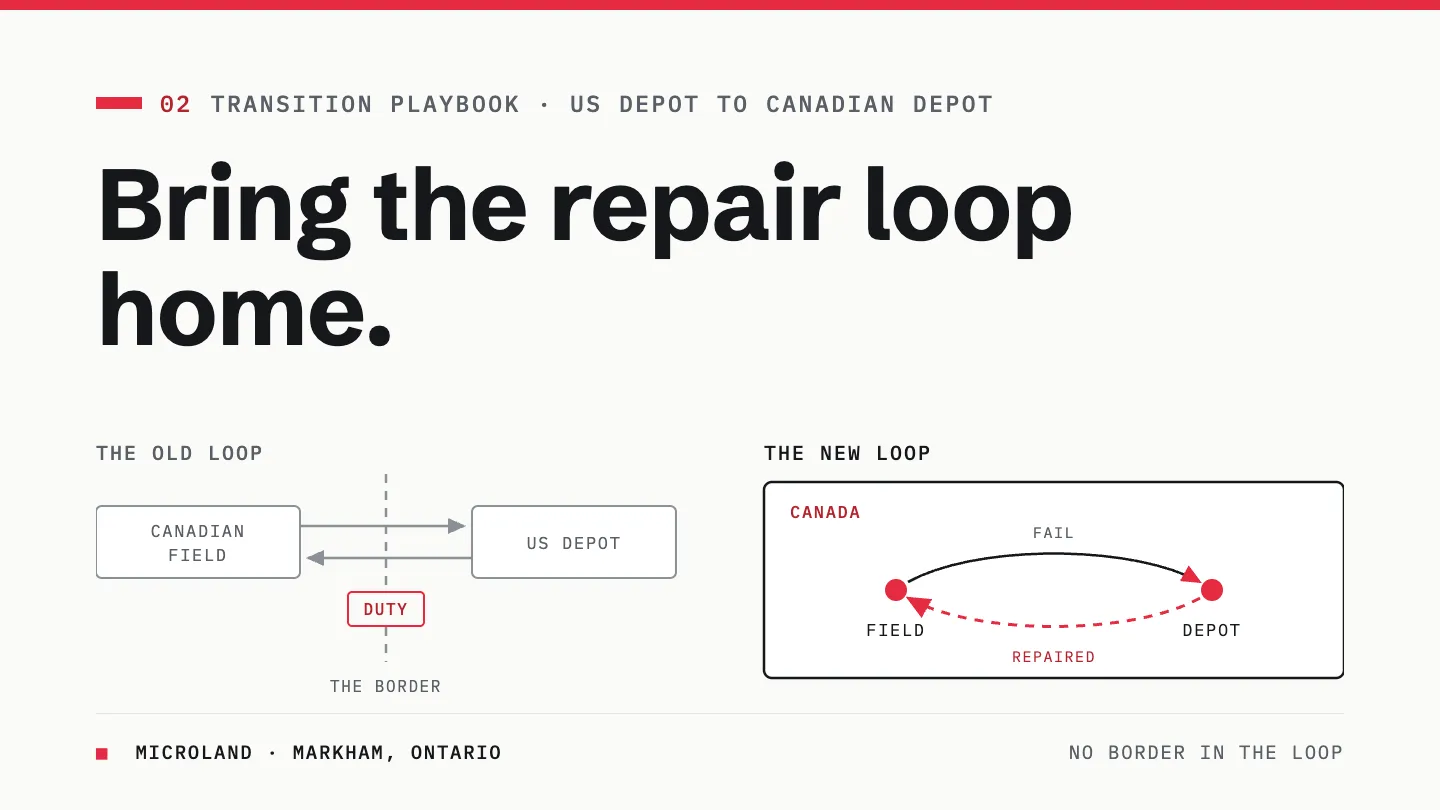
Moving a Canadian repair program from a US depot to a Canadian one is a sequenced project, not a switch-flip: audit what the incumbent is holding, stand up the program at the new depot, move buffer stock and the parts pool north, cut over new RMA intake on a fixed date while in-flight units finish at the old depot, then wind down and repatriate what’s left. Run in that order, the transition happens without a coverage gap. Run out of order, you get stranded inventory, dropped RMAs, and a customs bill you didn’t budget.
Here’s the playbook, starting with why so many programs are making the move right now.
Why move a Canadian repair program out of a US depot?
The typical setup we see: product is sold and installed in Canada, but when a unit fails, it ships south to a US depot for service and then comes back north. That arrangement was tolerable for years. It’s the border legs that have stopped making sense:
- Every RMA is now a tariff event. The 2025 tariff rounds put duties on cross-border movements that used to be routine, and repair traffic was not spared.
- You pay for two crossings per repair. Freight south, freight north, and brokerage fees on every shipment, all before a single minute of bench time.
- Customs time sits inside your turnaround clock. Border delays are unpredictable and outside anyone’s control, but the SLA miss still lands on you.
- The paperwork burden compounds. Proof of export, repair-value declarations, and per-shipment filings on every RMA. One error surfaces later as a duty bill.
- Trade policy keeps moving. Each new round reprices the loop overnight, and the case for keeping Canadian service in Canada has strengthened with every announcement since 2024.
- Currency mismatch. Repair invoices arrive in US dollars while the program’s revenue is in Canadian dollars, so exchange swings flow straight into cost of service.
- Data leaves Canadian jurisdiction. Any data-bearing device in the program crosses a border twice per repair.
- Your end customers feel the distance. Door-to-door time is longer for Canadian users, and tracking tends to go quiet at the border, which is exactly when they call you.
If one or two of those read like your last quarterly program review, you’re the reader this playbook is for. The rest of this post is the how.
What should you audit before the move?
Before anything ships anywhere, build a complete picture of what the incumbent depot is holding and what the program actually consists of. At minimum:
- Serialized unit census. Every unit currently at the US depot, by serial number and status: awaiting repair, in repair, repaired awaiting return, held for parts, scrapped-pending-approval. This list is your reconciliation baseline for the entire transition.
- In-flight RMAs. Open claims not yet received at the depot. These are the units that will still arrive at the old address after you’ve decided to leave.
- Buffer stock and exchange pools. What’s in the advance-exchange pool, what condition it’s in, and who owns it. Consignment terms decide what you can move and what you have to settle first.
- Parts pool. Your parts, the depot’s parts priced into the program, and any harvested-parts stock. Parts ownership is where transitions get contentious; sort it on paper before the wind-down conversation.
- Entitlement and history data. Warranty entitlement records, per-serial repair history, and test criteria. Get a full structured export commitment from the incumbent early; leverage drops fast once you’ve announced you’re leaving.
- Program documentation. Repair procedures, QA criteria, packaging specs, firmware versions. Anything that lives only in the incumbent’s heads has to be rebuilt; anything documented can be transferred.
How do you cut over RMA intake without dropping units?
Use a date-based cutover with a parallel-run window:
- Fix a cutover date. From that date, every new RMA routes to the Canadian depot. Claims approved before it finish at the US depot.
- Update every routing surface at once: RMA portal, warranty system, prepaid labels, packaging inserts, support scripts. The most common cutover failure is a label pointing at the old dock weeks after the switch.
- Let in-flight units finish where they are. Redirecting units mid-transit doubles their border crossings. Everything received at the US depot before cutover gets repaired and returned on the old path; the population drains on its own within one turnaround cycle.
- Stand up integration before the date, not after. If repair status feeds your ERP, CRM, or warranty platform, the new depot’s API integration should be live in a test environment during the parallel run, so cutover day changes where units go, not what your systems can see.
How do you protect SLAs during the transition?
SLA continuity comes from sequencing, not heroics:
- Move the buffer stock first. If the program includes advance exchange, the exchange pool ships north and is verified before cutover. Exchange SLAs are the ones end users feel same-day, so they’re the ones you protect first.
- Run first articles through the new bench. Before cutover, put a sample of real failed units through the Canadian depot’s full loop (intake, diagnosis, repair, QA, return) and sign off the results against your test criteria. Cutover day should not be the first time the new depot sees your product.
- Hold both depots to their clocks during the overlap. The incumbent still owes contracted turnaround on in-flight units; the new depot’s clock starts with its first production units. Track both against the same reconciliation list from your audit.
- Expect a ramp, and manage it with volume. Bench proficiency on a new product line builds over the first repair cycles. Ramping volume week over week during the parallel run, rather than switching 100% of intake on day one, keeps early turnaround honest while the operation beds in.
What happens at customs during the move?
Three flows cross the border during a transition, and each has its own treatment. This is where a customs broker earns their fee; the rules below are the map, not the filing:
- The final southbound leg. The last RMA batches you route to the US depot before cutover are temporary exports for repair. Document them like it matters, because it does: proof of export is what lets those units re-enter Canada without being taxed as new imports. Loose paperwork on the way south becomes a duty bill on the way north.
- Repaired units returning north. Units coming back from the US depot after repair re-enter under CBSA’s rules for goods returned after repair or alteration (Memorandum D8-2-26). Warranty repairs generally re-enter free of duty, while non-warranty repair value can attract duty and tax.
- Repatriating unrepaired stock and the parts pool. Buffer stock, parts, and units the incumbent never repaired come home under the returned-goods provisions (tariff items 9813.00.00/9814.00.00, Memorandum D8-2-27): duty-free if the goods weren’t advanced in value abroad and you can prove they were exported from Canada in the first place. That proof-of-export requirement is the single most common trap in depot repatriations.
One more reason the steady state should have zero border crossings: on the US side, goods returned after repair abroad are assessed under HTS subchapter 9802 on the value of the repair, and trade-law analysis of the 2025 tariff actions (Troutman Pepper Locke) found the new duties were not excluded for those repair provisions. Even the repair value performed in Canada can attract them. A cross-border repair leg is exposed to whichever tariff round comes next, and the measures have kept shifting into 2026. The destination model is a loop that never touches the border.
How long does the transition take?
Program size, SKU count, and contract terms move every number below; treat these as planning envelopes for a mid-sized program, not promises:
| Phase | What happens | Planning envelope |
|---|---|---|
| Audit and scoping | Serialized census, parts and pool ownership, data export, contract review | 2–4 weeks |
| Program setup at the new depot | SKUs, test criteria, repair procedures, parts sourcing, portal and API integration | 3–6 weeks, overlapping the audit |
| Stock and parts transfer | Buffer pool and parts pool move north, customs cleared, counts verified | 2–4 weeks |
| Parallel run and cutover | First articles signed off, intake ramps to the Canadian depot, cutover date passes | 2–4 weeks |
| Wind-down and repatriation | In-flight units drain, final reconciliation against the audit baseline, remaining stock comes home | 4–8 weeks tail |
| Stabilization | Turnaround and quality reviewed against SLA at full volume | First full quarter |
The overlap matters more than the total: a well-run transition has the new depot production-ready before the old one stops receiving, which is why the calendar time from decision to cutover is typically a quarter, while end users experience nothing at all.
What should you ask the receiving depot?
A short list that separates depots that have absorbed transferred programs from depots that haven’t:
- Have you taken over a program mid-stream before, and how did you handle the in-flight population?
- Can you hold and manage our buffer stock and parts pool, with both visible in your portal?
- What does first-article sign-off look like against our test criteria?
- Can RMA status and inventory positions feed our systems by API from day one?
- Who handles the customs paperwork on the repatriation shipments?
Microland runs repair and warranty programs entirely within Canada from Markham, Ontario: depot repair, advance exchange, and parts management under one roof, with every serial number tracked in a real-time portal and API integration for programs that run on data. If your Canadian volumes are still crossing the border for repair, talk to us about what the transition would look like, including taking the audit and cutover plan off your plate. The program side of this, what outsourced depot repair in Canada covers and what the receiving depot takes on, is laid out on its own page.