How to Sell Refurbished Without Cannibalizing New Sales
Cannibalization fear kills refurbished programs before they start. The research says the fear is oversized, and five controls turn refurb into a segment play instead of a discount race.

Most refurbished programs don’t die in the warehouse. They die in a meeting. Operations has the return stream, finance likes the recovery math, and then someone senior asks the question that ends it: “Won’t this eat our new sales?” Nobody has a rigorous answer, so the B-stock ages another quarter and the write-down grows.
The fear deserves a real answer. It’s the single most common reason refurbishment programs stall, and the evidence says it’s much smaller than it feels from inside the room.
The fear, measured
The classic study on this question ran actual auctions to measure willingness to pay for new versus remanufactured versions of the same products. The finding: the two products drew essentially different bidder populations, with scant overlap between them. The people bidding on remanufactured units were not the people bidding on new ones, and the authors concluded the cannibalization risk is lower than managers assume.1
Market data since then points the same direction. In smartphones, the most developed refurbished category, roughly 70% of refurbished buyers preferred a refurbished device over a brand-new entry-level model, not over a new flagship.2 Read that carefully: the refurbished unit competes against the bottom of the new lineup and against other brands’ cheap models, not against your full-price flagship. The $700 refurbished buyer was rarely your $1,000 buyer. More often they were a competitor’s $500 buyer, or nobody’s.
Two more data points for the meeting. Refurbished smartphone sales grew at roughly triple the rate of new in 2025.2 The demand exists whether or not you serve it. And one recent modeling study found the presence of remanufactured options can actually lift new-product sales, because the discounted tier anchors the new unit’s price as justified.3
There’s also a 2026-specific reason the math has shifted: the memory-price surge is gutting the economics of entry-level new hardware and pushing more buyers toward refurbished.4 The tier that refurbished sales supposedly cannibalize (cheap new units) is the tier vendors are abandoning anyway. We made the demand-side case for certified refurbished programs in April; this post is about the objection that stops them.
The tier already exists. The question is who runs it.
Here’s the uncomfortable part: your brand already sells refurbished. Marketplace sellers list it today: ungraded, inconsistently tested, priced however they like, with your logo on the box and none of your standards in the unit. We’ve written about what that uncontrolled channel costs in retail relationships and warranty pollution.
So the strategic question was never “should a discounted tier of our product exist?” It exists. The question is whether you run it with your grading, your warranty, and your pricing floor, or let third parties run it against you.
Apple settled this argument years ago: its Certified Refurbished program sells at savings of up to about 15%, with a full one-year warranty, and has run for years alongside the most protected premium pricing in consumer electronics.5 The program doesn’t erode the flagship price; it enforces a quality floor under the brand’s secondary market.
The five controls
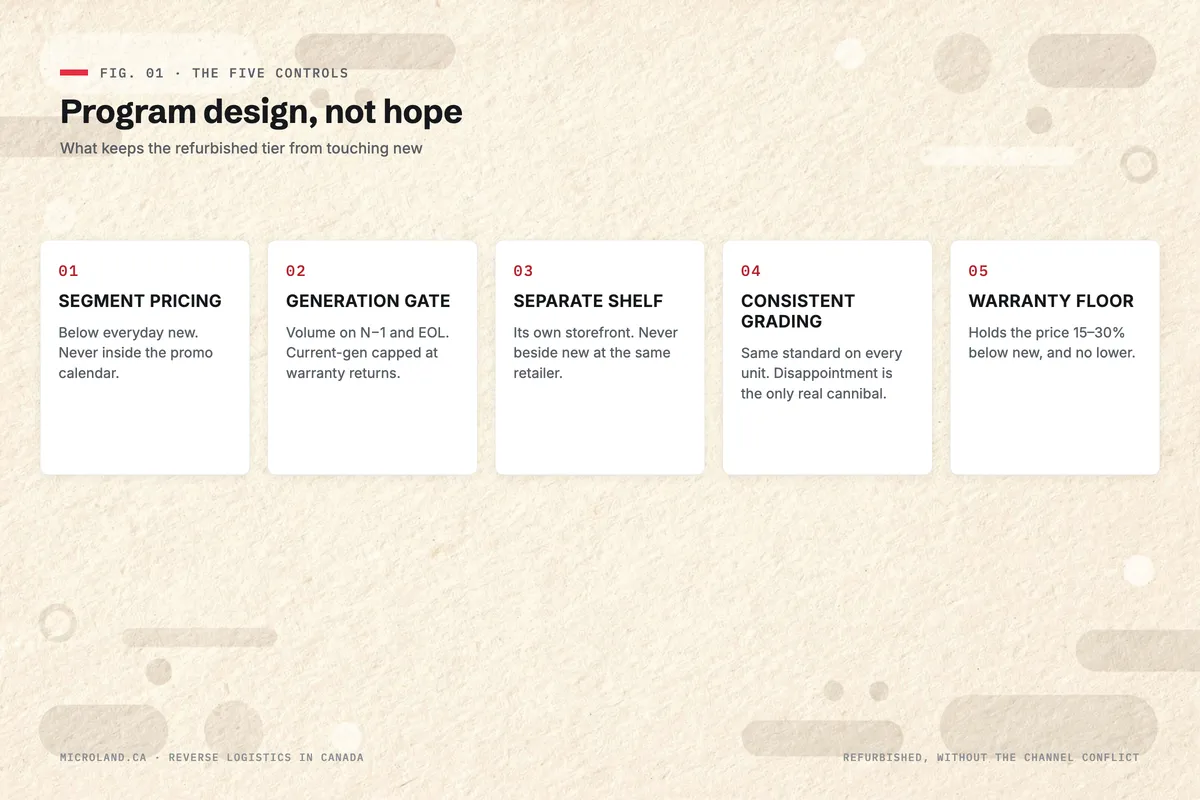
Program design, not hope, is what keeps the tiers apart. Five controls do the work:
-
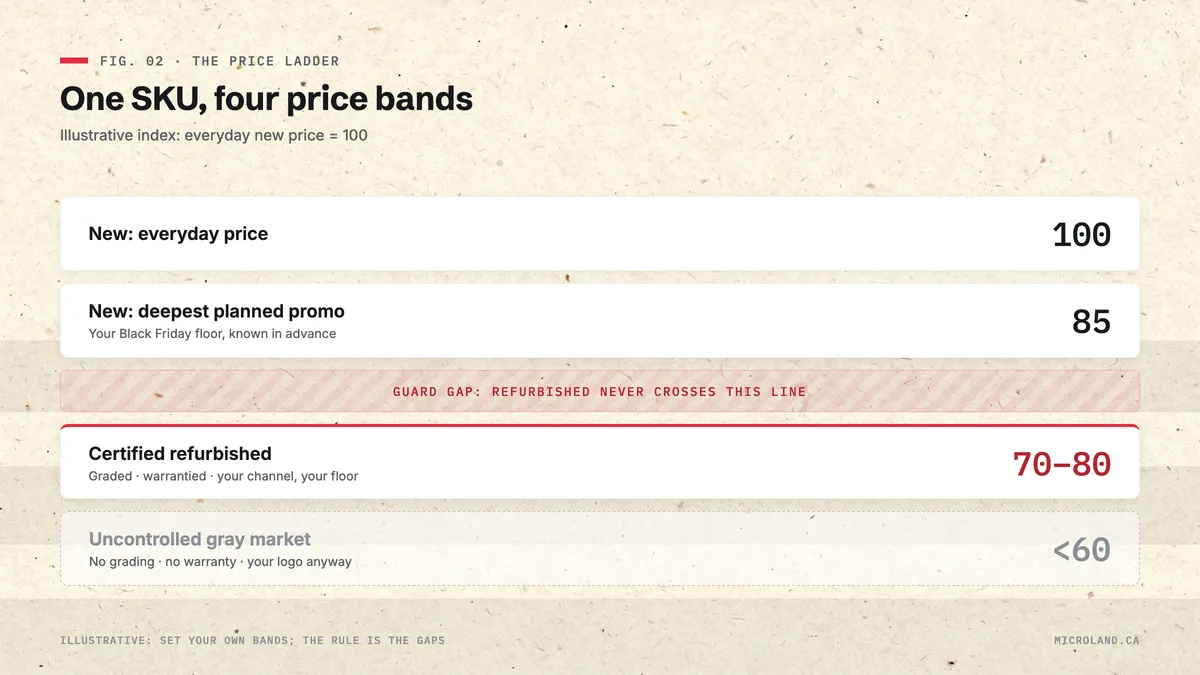
Price to segment, not to clear. The refurbished discount is a positioning decision. Wide enough to capture the buyer who was never paying full price; premium programs hold around 15%.5 Tight enough to stay clear of your own promo calendar. If Black Friday takes the new unit to $799, a $749 refurbished listing isn’t a segment, it’s a coin flip. Keep the refurbished price below your deepest planned promo on the same SKU, always.
-
Gate by generation. Open the volume taps on last-generation and end-of-life SKUs, where there is no new-unit sale left to lose: the buyer of a discontinued model literally cannot cannibalize it. Cap current-generation refurbished supply at what your warranty returns naturally produce.
-
Separate the shelf. Refurbished sells through its own channel, a dedicated storefront or outlet, not beside the new unit at the same retailer. Scope it geographically too: Canadian returns feeding a Canadian refurbished channel never leak into your U.S. pricing.
-
Grade like it’s the product. It is. The only way refurbished genuinely damages new sales is by disappointing: a bad refurbished unit reads as a bad brand experience. Consistent cosmetic and functional grading is what prevents that, which is why we grade with AI assistance instead of tired eyes at 4 p.m.
-
Warranty the floor. A real warranty is the price-floor enforcer. It’s what lets a certified unit hold 15–30% below new instead of racing uncontrolled sellers to the bottom, and it converts the skeptical buyer without touching the confident one.
The separate shelf, in practice: Skadi Electronics
For the programs we run, the separate shelf has a name. Skadi Electronics is Microland’s partner channel for selling your refurbished electronics in Canada: a direct-to-consumer store that sells refurbished only, and nothing new.
That structure is the point, and it maps straight onto the controls above:
- Refurbished only. Your product never sits beside its brand-new twin at a discount. There is no new listing on the site to undercut.
- Canada only. Canadian returns become Canadian refurbished stock and stay in this market. Nothing leaks across the border into other regions’ pricing.
- Your floor, enforced. Every unit is graded and warrantied at Microland before it lists, and price floors are set with the brand, not against it.
- Full traceability. Every serial number is tracked from return intake to final sale, so you always know where your product surfaced and at what price.
For an OEM or distributor, this is what a controlled channel means in practice: value recovery from the return stream without building a storefront, hiring a resale team, or finding your B-stock in places you never sanctioned.
The self-test
If your B-stock is aging in a warehouse while marketplace sellers move refurbished units of your product anyway, you don’t lack a refurbished channel. You lack control of the one that already exists.
This is the model Microland runs for OEMs and distributors as part of a full reverse logistics program: returns triage, repair, refurbishment, and consistent grading in our Markham facility, with controlled resale through Skadi at the end of the line. Your A-stock pricing stays clean, your retail relationships stay intact, and every price point stays yours to set.
If the cannibalization question has been the reason your returns keep getting liquidated for pennies, let’s have the meeting with the evidence on the table.
Footnotes
-
V.D.R. Guide Jr. and J. Li, “The Potential for Cannibalization of New Products Sales by Remanufactured Products,” Decision Sciences, 2010. https://onlinelibrary.wiley.com/doi/abs/10.1111/j.1540-5915.2010.00280.x ↩
-
Secondary Market News, “Refurbished and used smartphones continue to outpace new sales in 2025” (reporting Counterpoint Research data). https://secondarymarket.news/blog/refurbished-smartphone-market-2025/ ↩ ↩2
-
“Strategic Selection of Remanufacturing Business Models: A Consumer Perception Perspective,” arXiv, 2025. https://arxiv.org/pdf/2512.03732 ↩
-
The Recycler, “Memory shortage could lift refurbished IT demand,” 2026. https://therecycler.com/posts/memory-shortage-could-lift-refurbished-it-demand/ ↩
-
Apple, “Certified Refurbished Products” and “Why Refurbished.” https://www.apple.com/shop/refurbished · https://www.apple.com/shop/refurbished/about ↩ ↩2