Advance exchange in Canada: the replacement ships before the failed unit comes back.
When downtime costs more than hardware, repair-then-return is the wrong order. Advance exchange flips it: a working unit leaves the depot first, the failed one follows second. Your buffer pool is managed, repaired, and visible the whole time.
Standard depot repair asks the end user to wait: ship the failed unit, wait for repair, get it back. Advance exchange removes the wait. When a claim is approved, a working replacement ships from buffer stock held at the depot; the failed unit ships back afterwards and is repaired into the pool. For hardware that keeps a store lane open, a warehouse scanning, or an employee working, that ordering is the difference between a support program your customers tolerate and one they renew on.
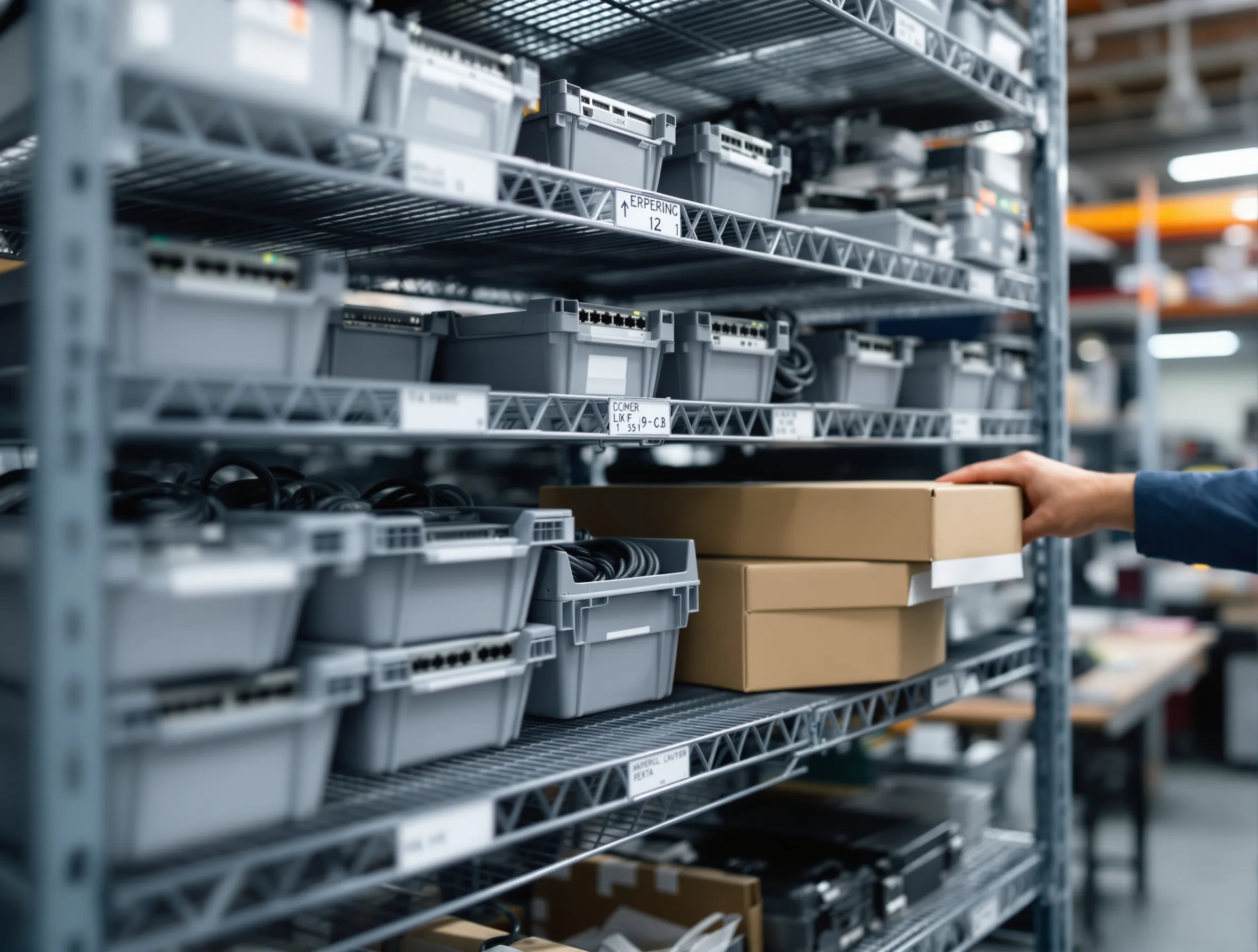
Microland holds and manages your buffer stock at the Markham, Ontario depot, serving exchanges across Canada, with no cross-border shipping, brokerage, or duty delays between your customer and their replacement. Because the exchange pool and the repair bench sit in the same building, returned failures cycle straight back into ready stock, and the portal shows you pool health at all times: what’s deployed, what’s in repair, what’s on the shelf ready to ship.
Advance exchange capabilities
Ship-first exchange fulfilment
Approved claims trigger an immediate shipment from your buffer pool. The end user or field site gets a working unit without waiting on the repair cycle.
Buffer stock ownership & management
Your exchange pool lives at the depot: received, stored, counted, and kept ship-ready, so you get the program without running the inventory operation behind it.
Failed-unit recovery & return tracking
Every exchange opens a return obligation that’s tracked to closure: outstanding units are visible per exchange, so pool leakage is caught early instead of discovered at count time.
Repair back into the pool
Returned failures route directly to the repair bench and re-enter ready stock once they pass test, so the pool replenishes itself instead of draining toward a re-buy.
Pool health visibility in the portal
Ready stock, units in repair, units in transit, and open returns: the full state of your pool in the customer portal, with the same data available over the REST API.
Program rules per partner
Entitlement checks, exchange approval flows, stocking thresholds, and replenishment triggers configured to your program, and extended by the in-house development team as it evolves.
How an advance exchange program runs
- STEP 01
Pool established
You seed the buffer stock; units are received, logged by serial, tested ship-ready, and placed into managed inventory at the depot.
- STEP 02
Claim & ship
An exchange request comes in through the portal, API, or your ticket flow; once approved under your program rules, a replacement ships from the pool.
- STEP 03
Failed unit returns
The defective unit ships back against the open exchange; its arrival is matched to the claim and the return obligation closes.
- STEP 04
Repair & replenish
The returned unit is diagnosed, repaired, and tested at the same depot, then re-enters ready stock, keeping the pool at strength.
- STEP 05
Monitor & adjust
Pool levels, exchange activity, and units stuck in any stage are visible in the portal, so stocking levels can be adjusted before availability becomes the problem.
Advance exchange questions we get
What is an advance exchange program?
It’s a support model where the replacement ships before the failed unit is returned. A pool of ready units is held at the depot; when a claim is approved, a replacement ships immediately and the defective unit comes back afterwards, is repaired, and rejoins the pool. The end user’s downtime is reduced to shipping time rather than shipping plus repair time.
Who supplies the buffer stock, and who manages it?
The stock is yours (typically seeded from new, refurbished, or repaired units), and Microland holds and manages it at the depot: receiving, serialized tracking, storage, keeping units ship-ready, and flagging when levels run low. You get the uptime benefit of a stocked exchange program without building the inventory operation yourself.
What happens to the failed units that come back?
They cycle back into your pool. Each returned unit is matched to its exchange, diagnosed, repaired, and tested at the same depot, then re-enters ready stock. Unrepairable units route to disposition under your rules. That repair loop is what keeps the pool self-sustaining instead of steadily shrinking toward a re-purchase.
How do we know the state of our exchange pool?
Through the customer portal: ready stock on the shelf, units in repair, units in transit, and exchanges with returns still outstanding, all by serial number. The same visibility is available over the REST API if you want pool state inside your own systems. Nothing about the pool should require a phone call to find out.
Why run advance exchange from a Canadian depot?
Because the whole point of advance exchange is speed, and a border in the middle of the loop works against it. Exchanges ship from Markham, Ontario to anywhere in Canada with no customs clearance, brokerage, or duties in either direction, for the outbound replacement or the returning failure.