Liquidation vs. Refurbishment: What's Best for Your Returns?
Liquidation or refurbishment for returned electronics? Compare recovery economics, channel cleanliness, and brand control, and learn when each wins.
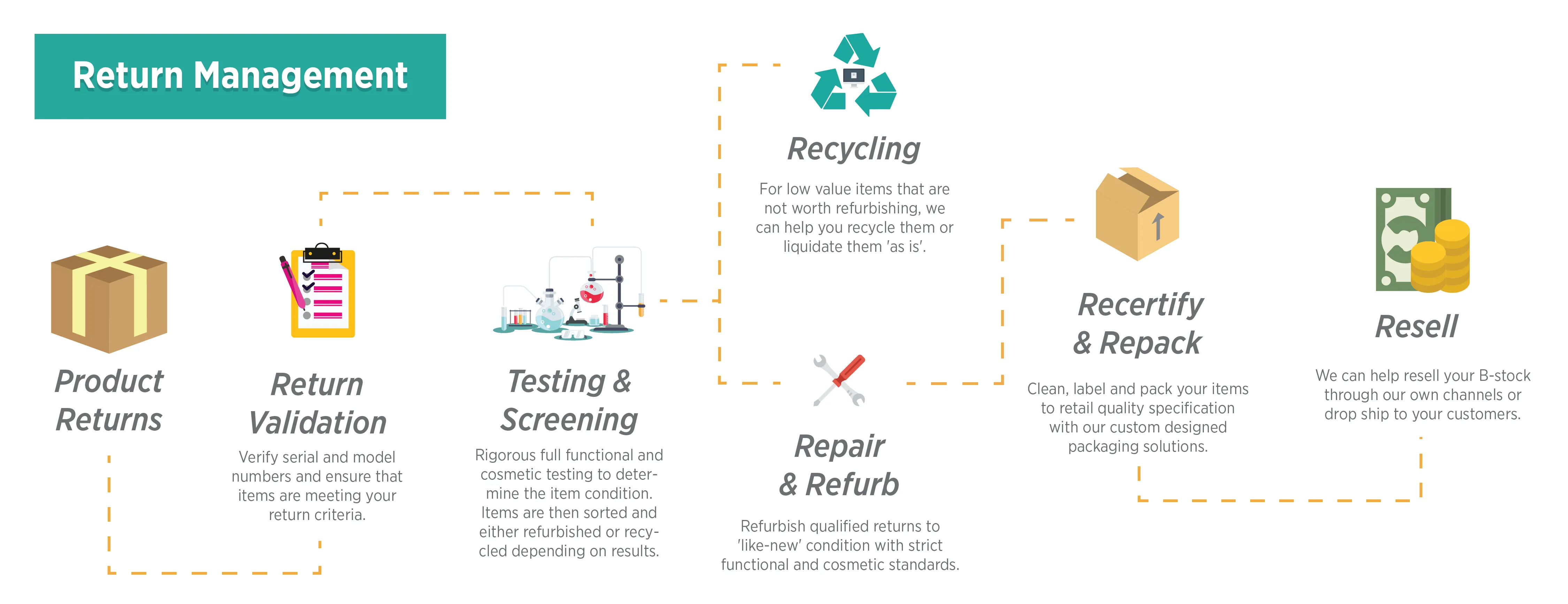
Every OEM, distributor, and retailer with a return stream eventually faces the same decision: when product comes back, do you liquidate it or refurbish it?
Both are legitimate disposition strategies. Both turn returned inventory into cash. But they behave very differently on three dimensions that matter most to a brand: how much money you recover, where the product ends up, and who controls your brand’s story on the secondary market. Get the choice wrong and you leave margin on the table. Or worse, you fund a gray-market channel that undercuts your own retail partners.
Here’s how the two options actually compare, and when each one wins.
What liquidation actually is
Liquidation means selling returned inventory in bulk, by the pallet or truckload, to a buyer who takes it as-is. Units are typically untested, ungraded, and unsorted. The liquidator assumes the risk of what’s inside, and that risk is priced in: bulk lots of untested returns routinely sell for a small fraction of original retail value.
The appeal is simple. Liquidation is fast, it requires no operational effort, and it converts a warehouse problem into a cheque. For a business drowning in returns with no processing capability, that has real value.
The costs are less visible:
- Deep discounting. Buyers price for the worst case, because a bulk lot mixes working units, damaged units, and empty boxes. You get paid as if everything is broken.
- Loss of control. Once the pallet leaves your dock, you have no say in where the product surfaces, at what price, or in what condition.
- Fees and freight. Auction fees, broker margins, and shipping all come out of an already-thin recovery.
What refurbishment actually is
Refurbishment means processing returns individually: receiving and triaging each unit, testing and screening it, repairing what’s repairable, grading it, repackaging it, and reselling it through a controlled channel. Units that can’t be economically restored are harvested for parts or responsibly recycled.
It’s more work than liquidation, but that work is exactly what converts a $0.10-on-the-dollar pallet into individually sellable, warrantied units. A large share of consumer electronics returns have no fault at all or only minor, fixable issues; buyer’s remorse and “no fault found” returns are among the most common categories in the industry. Liquidating those units means selling working product at broken-product prices.
Refurbishment recovers more per unit for three reasons:
- Testing removes the uncertainty discount. A tested, graded, working unit sells on its merits, not on a buyer’s worst-case assumption.
- Repair rescues borderline units. Screen swaps, port repairs, and even board-level component repair move units from “scrap” to “sellable”, and from low grades to higher ones.
- Single-unit resale beats bulk pricing. Selling individually through refurbished channels captures retail-adjacent pricing instead of wholesale-salvage pricing.
The comparison at a glance
| Dimension | Liquidation | Refurbishment |
|---|---|---|
| Recovery per unit | Low: bulk lots priced for worst case | High: tested, graded units sell individually |
| Speed to cash | Fast (days) | Slower (weeks), but continuous once the pipeline runs |
| Effort required | Minimal | Handled by you or a refurbishment partner |
| Channel control | None: product goes wherever buyers take it | Full: you choose the resale channel and pricing floor |
| Brand presentation | As-is, unbranded, often poorly represented | Graded, warrantied, professionally listed |
| Risk of undercutting A-stock | High | Low: controlled channels keep B-stock separate |
| Data security | Unmanaged | Data sanitization following NIST SP 800-88 media-sanitization guidelines |
| Sustainability story | Weak: much of the lot may end up scrapped | Strong: units stay in service longer |
Channel cleanliness: the hidden cost of liquidation
Recovery rate gets the attention, but channel contamination is often the more expensive problem.
When you liquidate, your product reappears wherever the liquidator’s buyers resell it: marketplace listings, flea-market-grade storefronts, cross-border gray markets. It shows up untested, misdescribed, missing accessories, and priced far below your retail channel. Three things follow:
- Your retail partners see it. Nothing sours a distributor or retail relationship faster than discovering the brand’s own returns are undercutting them online.
- Your warranty pipeline gets polluted. Liquidated units resurface as warranty claims and fraudulent returns, with no serial-number trail to catch them.
- Customers can’t tell the difference. A buyer who gets a dead unit from a liquidation reseller blames the logo on the box, not the reseller.
A controlled refurbishment program eliminates all three. Every serial number is tracked from return receipt to final disposition, resale happens in a designated channel at a managed price point, and the units that reach customers have actually been tested. That’s why premium brands overwhelmingly refurbish and resell through controlled channels rather than liquidate: brand equity is worth more than the marginal convenience of a bulk sale.
When liquidation wins
Refurbishment isn’t always the answer. Liquidation is the rational choice when:
- Unit value is too low to justify a touch. If a tested-and-graded unit sells for less than the cost of testing and grading it, bulk sale wins on math.
- Product is end-of-life or unsupported. No parts, no firmware, no resale demand. Move it out.
- You need cash and space immediately. A one-time warehouse clear-out is liquidation’s home turf.
- The category is commodity accessories. Cables, cases, and low-value peripherals rarely repay individual processing.
When refurbishment wins
Refurbishment wins whenever the product has meaningful residual value, which covers most of the electronics that come back:
- Mid- to high-value hardware: laptops, monitors, phones, POS terminals, A/V equipment, PC components.
- High no-fault-found return rates, where most units need only testing and repackaging.
- Brands that care where their product surfaces and what price it sells for.
- Ongoing return streams, where a standing pipeline beats episodic pallet sales.
- Warranty and service operations that can consume harvested parts, turning even unsellable returns into supply-chain value.
The practical answer: triage, then disposition
In practice, the best-run return streams don’t pick one strategy; they triage. Every incoming unit gets received, tested, and routed to its highest-value disposition: restock the untouched units, refurbish the fixable ones, harvest parts from the rest, liquidate or recycle the true tail. The economics are decided per unit, not per pallet.
That’s the model Microland runs for OEMs, distributors, and retailers as part of a full reverse logistics program: returns receiving and triage, testing and screening, refurbishment and grading, controlled resale, and parts harvesting, all in Canada, under one roof, with every serial number tracked in a real-time portal.
If your returns are currently leaving the building by the pallet, the odds are good you’re selling working product at broken-product prices. Talk to us about what a triage-first program would recover from your return stream.