Returns Are Your Secret Parts Supply Chain
Returned products are a ready-made source of repair parts: cheaper, faster, and better matched to demand than factory orders. Here's how harvesting works.
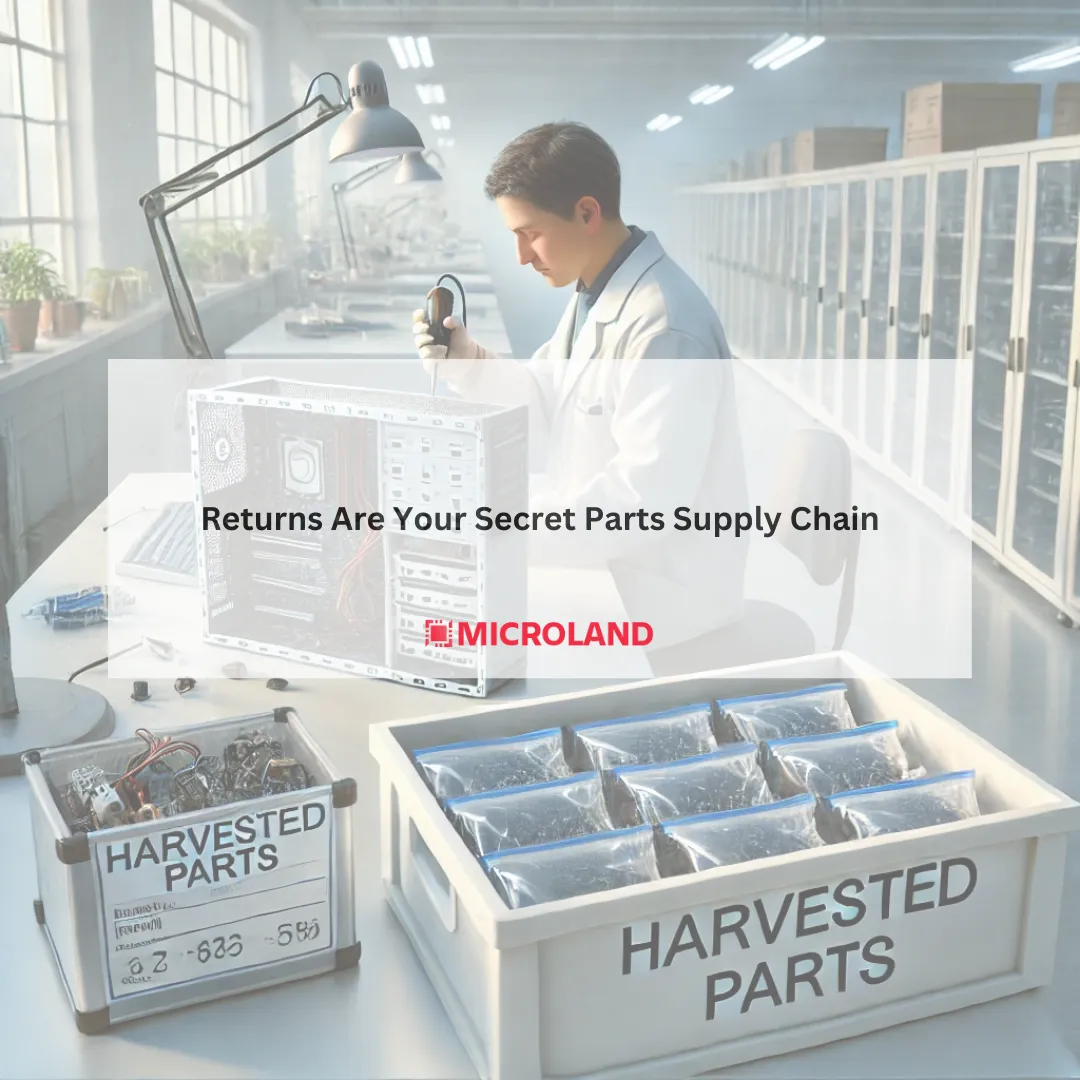
If you run a repair or warranty operation, you have a parts problem: replacement components are expensive to source, slow to arrive, and prone to shortages at exactly the wrong moment. Meanwhile, somewhere in your network sits a pile of returned product full of the very parts you’re waiting on.
Returns are more than a liability to be dispositioned. They’re a parts supply chain hiding in plain sight.
The problem with factory-sourced parts
Ordering replacement parts through factory production runs is inefficient and expensive. Minimum order quantities force you to buy more than you need. Global shipping adds cost and weeks of lead time. And when a part is back-ordered, the delay cascades: a repair that can’t be completed on time often gets escalated to the costliest resolution of all: replacing the entire unit instead of fixing it.
Every service organization knows this failure mode. A missing $15 component turns into a $600 whole-unit swap because the part was eight weeks out.
Harvesting: the returned unit as a parts donor
The alternative is to treat returns that can’t be economically resold as parts donors. Disassemble them, test the components, and feed the good ones straight into your repair operation.
The advantages compound:
- Cost savings. Disassembling returned products lets you extract usable parts at a fraction of the cost of ordering new ones: no MOQs, no factory pricing, no international freight.
- Immediate availability. Harvested parts are on the shelf now, not on a boat. Repair turnaround times drop because the queue stops waiting on inbound stock.
- Shortage insurance. A steady flow of returns means a steady flow of components, which minimizes the stockouts that trigger expensive whole-unit replacements.
- Sustainability. Every harvested component is one that didn’t need to be manufactured and one less piece of e-waste, a story that resonates with environmentally conscious customers and ESG mandates alike.
The demand-matching effect
Here’s the part most businesses miss: your returns mirror your sales. The products that come back in volume are your best sellers, which are exactly the products generating the most repair demand.
That makes harvested inventory self-balancing in a way factory orders never are. You don’t have to forecast which parts you’ll need; your return stream automatically skews toward the components your service operation consumes most. High-failure, high-volume models supply their own spares.
What it takes to do this well
Parts harvesting sounds simple (take things apart, keep the good bits), but doing it at scale requires real infrastructure: triage to identify donor candidates, testing and screening to verify components before they’re trusted in a repair, inventory systems to track harvested stock by part and grade, and repair capability deep enough to actually use what’s recovered. Where component- and board-level repair skills exist, even individual boards become recoverable assets rather than scrap.
That’s the machinery Microland has built over three decades of repair and returns processing work: returned units are triaged, donors are systematically harvested, and recovered components feed both our repair benches and our customers’ parts programs.
If your service operation is paying factory prices and factory lead times while your returns get scrapped or liquidated, you’re funding both ends of a problem that solves itself. Talk to us about turning your return stream into your parts supply.