Bill C-267: What Canada's Proposed Repair Framework Means for Brands Selling Here
The House of Commons is studying Bill C-267, a national durability and repairability framework for electronics and appliances. Microland testified at committee. What the bill would do, where it is likely to push service obligations, and what manufacturers selling in Canada should do now.
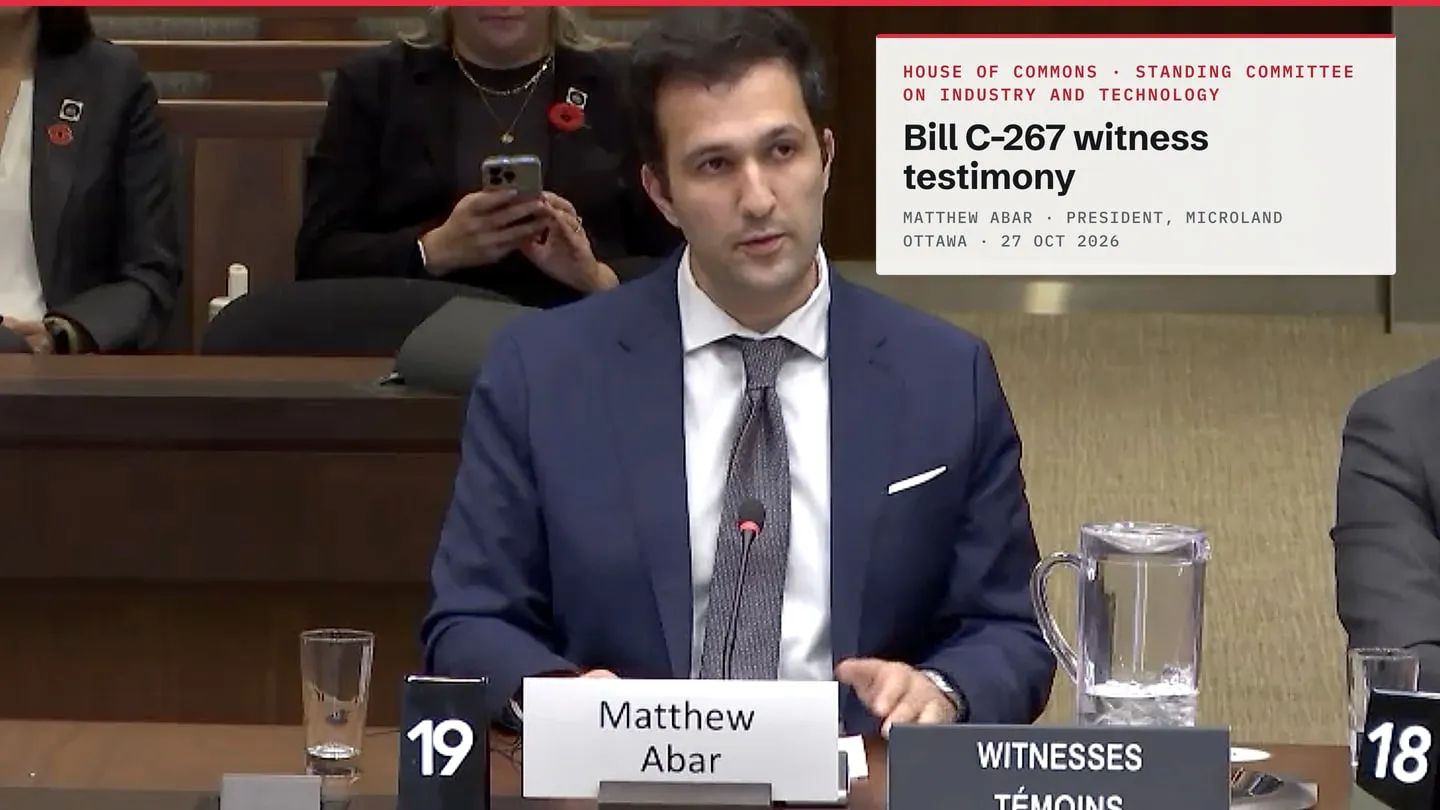
Canada is building a federal rulebook for how long electronics and appliances have to last and how they get repaired. Bill C-267 passed second reading in June and is now in front of the House of Commons Standing Committee on Industry and Technology (INDU), which spent three October meetings hearing from consumer groups, manufacturer associations, repair advocates and the repair industry. Microland’s president, Matthew Abar, testified on October 27, alongside the Canadian Anti-Monopoly Project and Repair Café Toronto.
This post is for manufacturers, importers and distributors whose products are sold in Canada. It covers what the bill would actually do, where the obligations are likely to land, and what to do about it now.
The short version
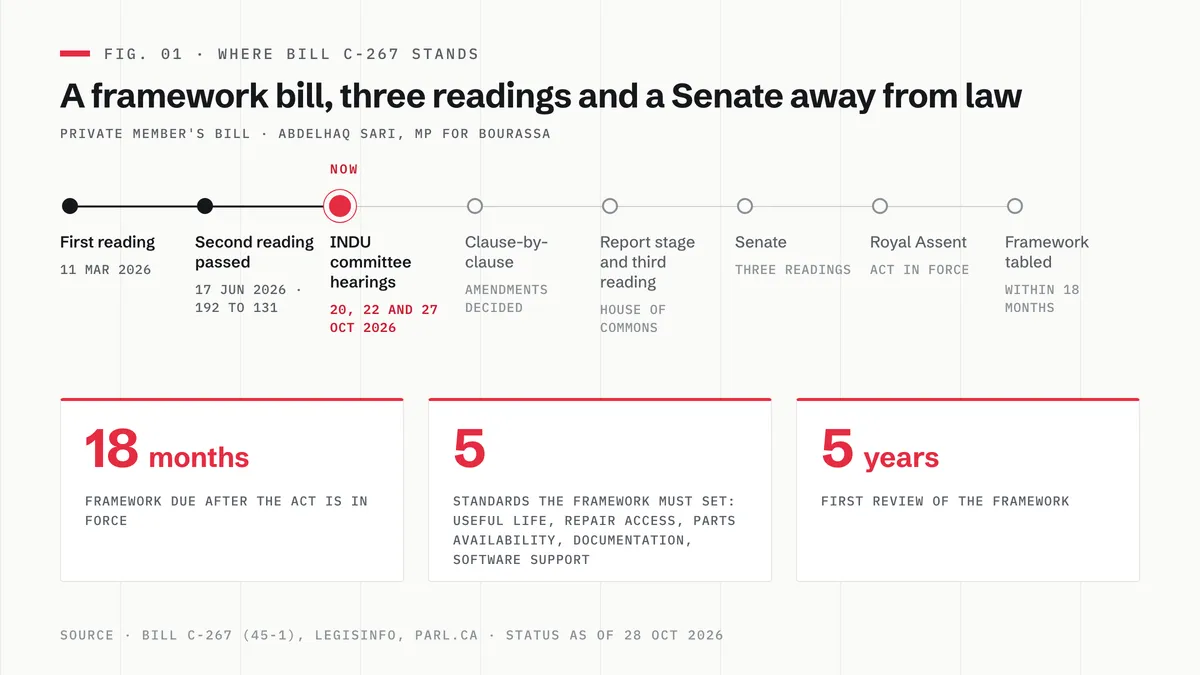
- It is a framework bill, not a right to repair law. It would require the Minister of Industry to produce, within 18 months of the Act coming into force, national standards on useful life, access to parts, tools and information, parts availability periods, technical documentation and software support. Enforceable obligations would come later, through federal or provincial legislation.
- The bill says how long parts must be available, but not where. For electronics, which can be boxed and shipped anywhere, that location question decides most repair outcomes, and it is the gap to plan around.
- The practical deadline is already set by Québec. Bill 29’s disclosure and parts-availability rules have applied since October 2025 and its warranty of good working order since October 2026. Whatever C-267 becomes, both levels of government are heading the same way.
- A documented Canadian repair story is the answer to both, and it does not require building a depot.
What Bill C-267 is
Bill C-267 is a private member’s bill sponsored by Abdelhaq Sari, Liberal MP for Bourassa. It was introduced on March 11, 2026, passed second reading on June 17, 2026 by a vote of 192 to 131, and was referred to INDU.
It directs the Minister of Industry to develop a national framework on the durability and repairability of electronic products and essential home appliances sold in Canada, whether made here or imported, in consultation with provincial consumer-protection officials. The framework must include national standards on:
- minimum useful life, and how it is labelled or displayed
- maintenance and repair, including access to parts, tools and information
- availability of replacement parts, and how long they must stay available
- technical documentation
- the duration and conditions of software support
The Minister must also discuss with the provinces what legislative measures could follow: obligations on manufacturers, importers and distributors, inspection mechanisms, and penalties. The framework is tabled in Parliament, published, and reviewed within five years.
What it means for a brand selling in Canada
The gap: how long parts must be available, not where
A refrigerator is repaired in the home and a car at a local garage. A laptop, phone or speaker can be boxed and shipped anywhere, and that one fact decides a lot of repair outcomes.
Many brands selling in Canada route Canadian repairs through, and ship replacement parts from, a service network outside the country, usually because that network already existed before they entered Canada. The product crosses the border twice. The customer waits longer, often pays shipping and brokerage, and in many cases decides the repair is not worth it. The bill addresses how long parts must be available, but not where they and the repair service are located, and for electronics that often decides whether a product gets repaired at all.
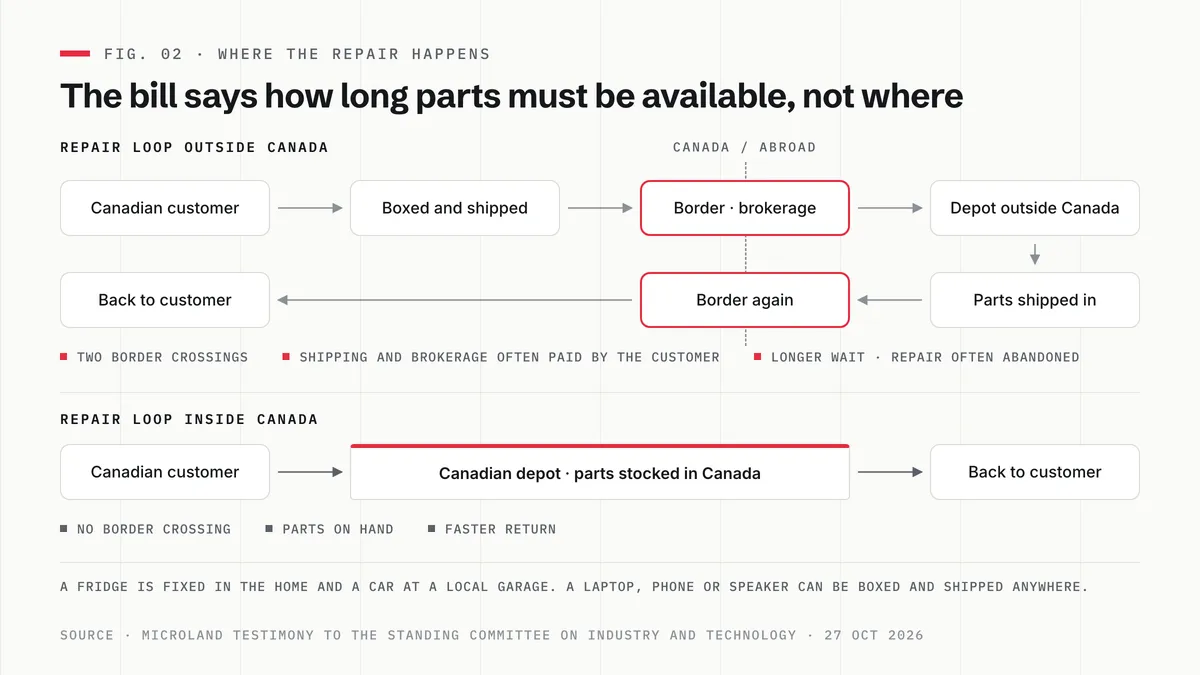
That gap is where Microland expects the pressure to land, from the framework, from Québec, and from retailers who now have to disclose repairability at the point of sale. A brand that can say “parts are stocked in Canada and warranty repair happens in Canada” meets every version of the rule. A brand that cannot will be explaining shipping days and brokerage charges to a regulator, a retailer or a customer.
Why one national standard beats ten provincial ones
Canadian repair volumes are small next to the US and Europe. For most manufacturers it is not economical to run more than one authorized service partner in Canada, so they consolidate into one. There is not enough volume to justify a different repair and service program in each province, and if the rules diverge, the simplest response for a manufacturer is to centralize service further, often outside Canada.
That is why the bill’s federal-provincial consultation is its most important feature, and why Québec’s Bill 29, already in force, should inform the framework rather than be reinvented province by province. One national standard, developed with the provinces, gives manufacturers a reason to invest in service here.
The lever to plan for: longer warranty periods
One more thing worth planning for, because it is the tool legislators in the EU and Québec have already reached for: mandated minimum warranty periods. The EU’s legal guarantee and Québec’s new warranty of good working order both set a floor on how long a product has to keep working, without saying anything about how it is built.
A longer mandated warranty changes the economics of what happens after the sale. If a product is covered for five years instead of two, every failure inside that window is the manufacturer’s cost, and the cheapest way to resolve a warranty event is a repair close to the customer, not an exchange or a refund shipped across a border. Repairable design, parts stocked in-country and a nearby service network stop being compliance items and become the way a brand protects its own margin. Governments like this lever because it sets the outcome and leaves the design choices to manufacturers and the market, so it is a reasonable bet that Canada’s framework consultation will look at it. Brands with an in-country repair loop already in place are the ones for whom a longer warranty is a cost line, not a crisis.
What happens next
Committee consideration continues with clause-by-clause review, where amendments are decided, then report stage and third reading in the House, then the Senate. Even once passed, the framework itself is 18 months out, and any enforceable obligations would come later, through federal or provincial legislation identified in the consultation. We track the broader picture, including Bills C-244 and C-294 and the provincial moves, in our Canadian right to repair status report.
Microland provides the infrastructure every version of this rule assumes a brand has: Canadian depot repair, parts distribution, refurbishment and responsible disposition, run from Markham for brands across consumer electronics, IT, A/V and point of sale. If your products are sold in Canada and serviced somewhere else, talk to us before the framework, or your customers, make the decision for you.
Frequently asked questions
What is Bill C-267?
Bill C-267, the National Framework on the Durability of Electronic Products and Essential Home Appliances Act, is a private member's bill sponsored by Abdelhaq Sari, Liberal MP for Bourassa. It would require the Minister of Industry to develop, within 18 months of the Act coming into force and in consultation with the provinces, a national framework on the durability and repairability of electronics and essential home appliances sold in Canada, including standards on useful life, access to parts, tools and information, parts availability periods, technical documentation and software support. It passed second reading on June 17, 2026 and is being studied by the Standing Committee on Industry and Technology.
Does Bill C-267 require repairs or spare parts to be located in Canada?
No. As introduced, the bill addresses how long replacement parts must stay available but not where parts are distributed from or where repairs are performed. For electronics, which are boxed and shipped for repair, that location decides most repair outcomes, so brands selling in Canada should plan for parts and warranty repair in-country whether or not the final framework requires it. Independent Canadian repair depots and parts distributors can run that program without the brand building its own operation.
Is Bill C-267 law yet?
No. As of October 28, 2026 it is at committee stage in the House of Commons after passing second reading 192 to 131 on June 17, 2026. It still needs clause-by-clause review, report stage and third reading in the House, then three readings in the Senate and Royal Assent. Even then, it creates a framework rather than enforceable obligations; the framework is due within 18 months of the Act coming into force.
How does Bill C-267 relate to Québec's Bill 29?
Québec's Bill 29 is provincial law already in force: repairability disclosure and parts availability obligations have applied since October 2025 and a warranty of good working order since October 2026. Bill C-267 is a federal framework bill that directs the Minister of Industry to consult the provinces and set national standards. Microland's position is that one harmonized national standard matters because Canadian repair volumes are too small for manufacturers to run a different service program in each province.
What should a manufacturer selling in Canada do about Bill C-267 now?
Get the Québec Bill 29 disclosure in order first, since it is the obligation already in force. Then stock service parts in Canada and move warranty repair in-country for the product lines where cross-border repair loops are losing customers. None of this requires building a depot: independent Canadian repair depots and parts distributors can run the program, and a documented Canadian repair story is what both the federal framework and provincial rules are heading toward.
Who did Microland represent at the committee?
Matthew Abar, President of Microland Technical Services, appeared on October 27, 2026 as a witness. Microland is an independent electronics repair depot in Markham, Ontario, operating since 1994 and acting as an authorized service centre for dozens of consumer and commercial electronics brands, which places it between manufacturers and Canadian customers on every repair.