What Is Depot Repair? How It Works, Costs, and When to Use It
Depot repair explained: the centralized mail-in repair model, the five-step process, what actually drives cost per unit, and when it beats field service.
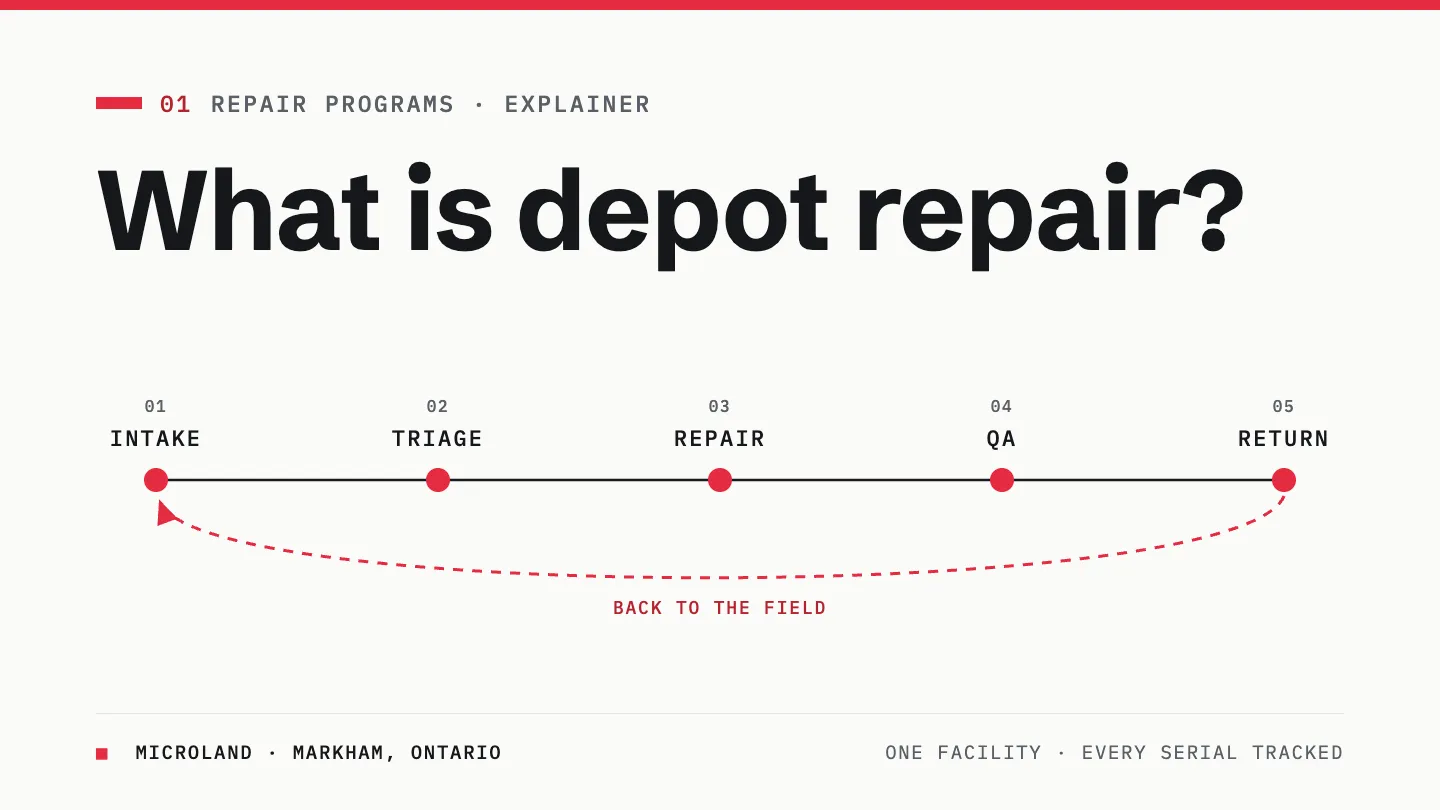
Depot repair is the centralized model for servicing hardware: instead of sending a technician to each failed device, failed units ship to one repair facility (the “depot”), where they’re diagnosed, repaired, tested, and shipped back. It’s how OEMs, distributors, and enterprises support product in the field at scale, because one facility with one process produces predictable cost per unit, consistent quality, and a single data view of every device in the loop. The trade-off is transit time, which is why depot programs are usually paired with defined turnaround SLAs and, where uptime is critical, advance exchange.
Here’s how the model works, what it costs, and when it’s the right choice.
Who uses depot repair?
Depot repair is the default engine behind most hardware support programs:
- OEMs running in-warranty and out-of-warranty repair for product sold into a market, the core of a repair and warranty program.
- Distributors and retailers processing returns, DOA units, and B-stock.
- Enterprises and service providers maintaining fleets of POS terminals, scanners, laptops, A/V hardware, and other working equipment.
- Consumers, any time a single device ships in for mail-in warranty or paid repair. That’s the same loop at a quantity of one, running on the same intake, diagnosis, and QA process as a thousand-unit OEM contract.
If a device can be boxed and shipped, its repair program can be depot-based. That covers most electronics below the size of a rack or a kiosk.
How does the depot repair process work?
Every depot program is a variation of the same five-step loop, with each unit tracked by serial number from first scan to final ship:
- Intake. Units arrive by mail-in or bulk shipment and are checked in against an RMA or manifest. Each serial number enters the system individually. This is where accountability starts.
- Triage and diagnosis. Technicians verify the reported fault and determine the repair path. In-warranty units proceed under the program’s coverage rules; out-of-warranty units generate an estimate for approval before work begins.
- Repair. The work itself can be anything from a part swap to board-level component rework for faults that run deeper than a module replacement.
- Quality assurance. Repaired units pass functional testing against agreed criteria before they’re allowed to ship. Failures loop back to the bench.
- Return. Units ship back to the end user, your stock, or the field, with the complete repair history retained per serial number.
The step most programs underestimate is triage. Accenture’s widely cited returns research found that around 68% of consumer electronics returns are “no fault found”: the product works, and the problem was setup, expectations, or user error. A depot that catches those units at diagnosis, instead of putting them through a full repair cycle, changes the economics of the whole program.
What does depot repair cost?
Depot repair is normally priced per unit or per repair event, sometimes with a diagnostic fee for no-fault-found and beyond-economic-repair outcomes. The rate itself is driven by a handful of factors:
| Cost factor | Why it moves the price |
|---|---|
| Product complexity and fault mix | A headphone headband swap and a BGA reflow on a motherboard are different jobs. The deeper the typical fault, the higher the bench time per unit. |
| Volume and predictability | Steady, forecastable volume lets the depot staff and stock parts efficiently; spiky or low volume carries a premium. |
| Parts strategy | New OEM parts, harvested parts from scrap units, or customer-supplied stock each carry very different costs; parts are usually the largest variable after labour. |
| Turnaround commitment | Tighter SLAs require more reserved bench capacity and parts on the shelf. A 5-day commitment costs more to deliver than a 15-day one. |
| No-fault-found rate | Every NFF unit consumes intake, diagnosis, and testing without a billable repair. High NFF rates need a defined (and priced) handling path. |
| Freight and packaging | Who pays shipping in each direction, and whether units move individually or consolidated in bulk, meaningfully shifts total program cost. |
| Integration and reporting | Manual status emails are cheap for the depot and expensive for you. Real API integration moves that cost out of your team’s week. |
The honest answer to “what does depot repair cost?” is that it’s quoted per program, from your product mix, fault profile, and volumes. Any flat rate quoted without those inputs has a margin of error built in that you’ll eventually pay for.
When does depot repair beat field service?
Field service sends a technician to the device; depot repair sends the device to the technician. The deciding factor is usually cost per incident: the Technology & Services Industry Association has estimated the fully loaded cost of a single field-service truck roll at roughly $1,000 per dispatch once labour, vehicle, and overhead are counted. A depot repair event on shippable hardware typically runs at a fraction of that.
Depot repair wins when:
- The device is shippable and doesn’t need to be fixed in place.
- Faults require bench equipment (diagnostics, rework stations, test rigs) that can’t ride in a van.
- The installed base is geographically spread out, which in Canada it almost always is. One depot serves Vancouver and St. John’s identically; a field network that covers both is expensive to build and brutal to keep consistent.
- You need per-unit quality control and history: every unit passing the same test criteria, every serial number carrying its record.
Field service keeps the edge when equipment physically can’t move (installed kiosks, large-format hardware) or when a contractual response time is measured in hours on site. That makes it less of an either-or choice than it looks: most programs need both, and running them under one provider is how you avoid paying the coordination cost yourself. Microland runs field services across Canada alongside the depot, on one contract, so a unit that can’t be fixed at the site continues on a repair bench under the same ticket.
How do you handle downtime while the unit is at the depot?
This is depot repair’s known weakness: the user is without the device while it’s in the loop. The standard answer is advance exchange. A working replacement ships from buffer stock the moment a claim is approved; the failed unit follows behind it and is repaired back into the pool. The end user’s downtime becomes the courier’s transit time, not the repair queue’s, while the economics stay depot economics.
Most mature warranty programs run both: depot repair as the engine, advance exchange layered on top for the SKUs where uptime matters.
Why does the depot’s location matter?
For a Canadian installed base, the border is the hidden line item. Routing Canadian units through a US depot adds cross-border freight, customs brokerage, duties, and unpredictable delays, in both directions, on every RMA. A Canadian depot keeps the entire loop in-country: no tariff exposure, no customs time in the turnaround clock, and devices (plus any data they carry) staying under Canadian jurisdiction for the whole cycle.
Microland runs depot repair from Markham, Ontario for OEMs, distributors, and enterprises across Canada: intake through QA under one roof, every unit visible by serial number in a real-time portal, with advance exchange and board-level repair in the same building. If you’re scoping a depot program, or paying a US depot’s border costs on a Canadian installed base, talk to us.